Recent years have led consumers to a general awareness of the need for more responsible, more local consumption.
This growing awareness has taken hold in many sectors, including the wine industry, with the emergence of urban wineries. But what exactly is an urban winery? How can wine be produced in an urban environment? The team at Chai Saint Olive®, Lyon's first urban winery, explains.
Urban wine cellar: what is it?
Wineries are generally located on vineyards far from urban areas. But with the movement towards more local consumption, numerous direct distribution initiatives and new concepts have emerged, such as the urban winery.
The term "chai" refers to a place where all the stages of winemaking take place , from the arrival of the grapes to their bottling. Winemaking encompasses the entire process of wine production.
Starting in New York, then spreading to London and Paris, urban wineries are experiencing a surge in popularity, much appreciated by city dwellers. This closer connection between vine and glass in an urban setting sparks their curiosity about the different stages of winemaking within an urban winery.

How to make wine in an urban winery?
Winemaking involves four main stages to transform grape juice, also known as grape must, into wine. Whether it takes place in an urban winery or a winery located on a rural estate outside city centers, the winemaking stages remain the same.
-
Arrival of the grapes
Once the grapes have been harvested, there are two possibilities to start the winemaking process:
If it's white: the grapes are pressed to extract the juice. This juice is called must, which is then placed in vats for alcoholic fermentation to take place.
If it's red wine: the grapes are placed in the vat either as whole bunches or destemmed (without the stems); this is called maceration. During this maceration, alcoholic fermentation takes place. At the end of fermentation, the grapes are removed from the vat and then pressed. This is referred to as partially fermented must.
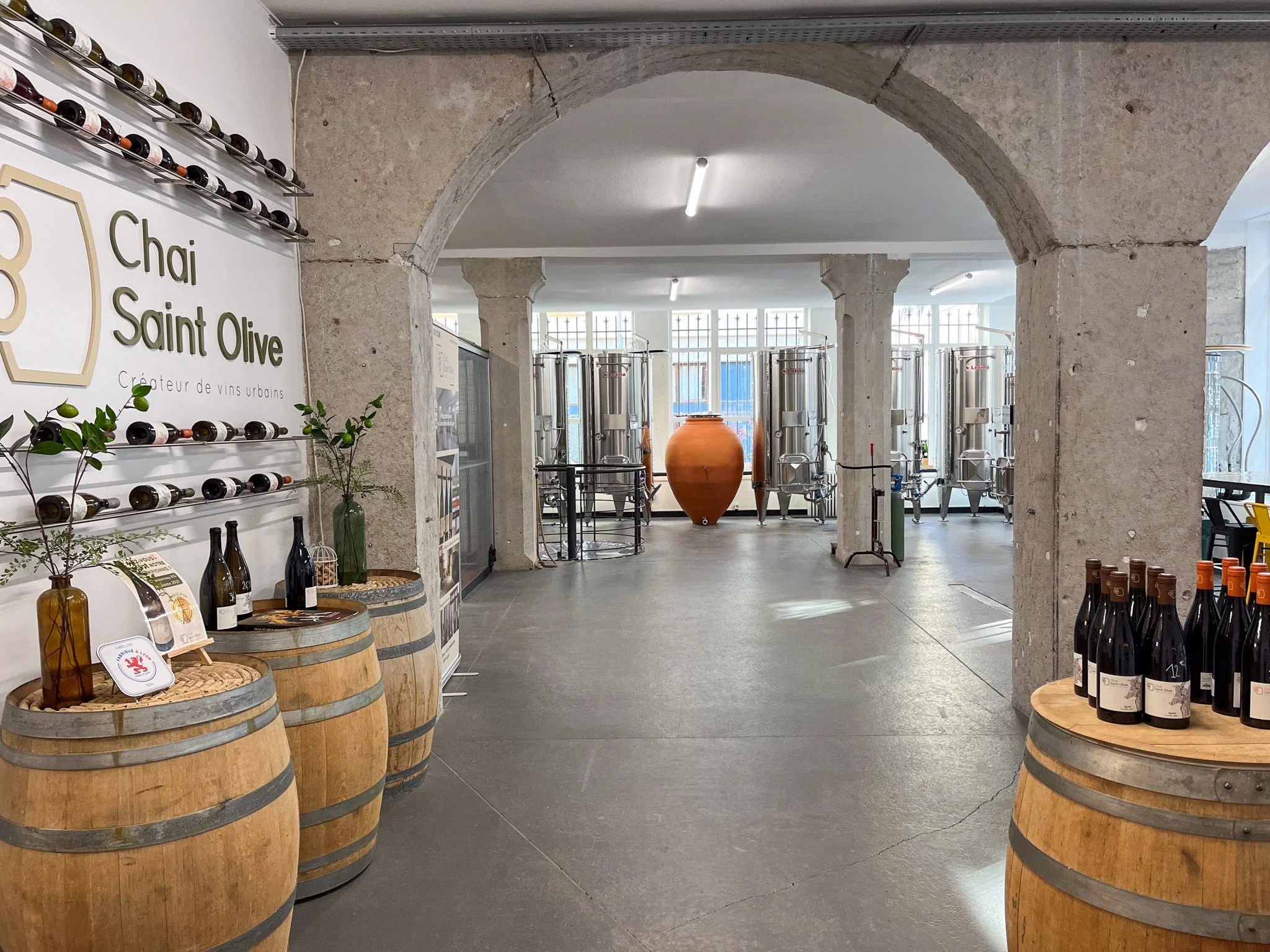
At the Lyon urban winery – Chai Saint Olive – the partially fermented grape must is delivered within 24 hours of pressing, then placed in temperature-controlled stainless steel tanks, oak barrels, or amphorae . The winemakers, located within 80 km of the winery, deliver the must directly.
-
Winemaking process
Winemaking is the process of transforming grape must into wine. Once in the vat (or barrel), the sugar in the grapes or must is converted into alcohol by yeast . These yeasts can be natural, meaning those that are naturally present on the grapes, or they can be introduced by the winemaker. In the latter case, they are called selected yeasts.
At Chai Saint Olive, we use selected natural yeasts that are certified organic . This allows us to control fermentation and avoid the presence of undesirable yeasts that could alter the taste of the future wine.
Next comes malolactic fermentation. This is the transformation of malic acid (responsible for acidity) into lactic acid (responsible for fats), in other words, deacidification. It's the action of a natural bacterium that is difficult for winemakers to control because it varies and is unstable from year to year. This step is mandatory for red wine but not necessarily for white wine; it depends on the winemaker's choice.
At Chai Saint Olive, we carry out partial malolactic fermentation on our Chardonnay white wine. This means we allow the bacteria to do their work in one vat and stop it in the other by cooling the vat to a low temperature to kill the bacteria and prevent it from spreading. The two vats are then blended.
For our Viognier, we practice 100% malolactic fermentation.
-
Livestock farming
The aging process begins once fermentation is complete. It allows the wine to mature, soften, and develop its flavor. This is when the aromatic profile is defined.
There are several types of containers, in different shapes and sizes. The winemaker's choice is paramount. Part of the wines produced at Chai Saint Olive is aged in stainless steel tanks to impart aromas of fresh fruit , and the other part in oak barrels to reveal more complex aromas .
Since September 2024, the Chai Saint Olive team has adopted a new winemaking method: the terracotta amphora . It has found a place of choice between stainless steel tanks and opens a complementary path of aromas: that of the balance between substance, fruit and finesse .
-
Bottling
This is the final step before tasting and sale.
Example: The Lyon-based urban winery Chai Saint Olive® has opted for gravity-fed bottling. This means that the wine, vinified in stainless steel tanks located on the ground floor, is conveyed through pipes to the bottling station in the winery's basement. This prevents the wine from being agitated by a pump before being sealed in its bottle for months or even years.
Why an urban winery in Lyon?
The founders of Lyon's first urban winery, Franck & Grégoire Saint Olive, shared this common desire to have their own wine production tool by internalizing the entire winemaking process.
With this idea in mind, they looked for a suitable location in Lyon to create Lyon's first urban winery, with the desire to introduce city dwellers to wine production methods.
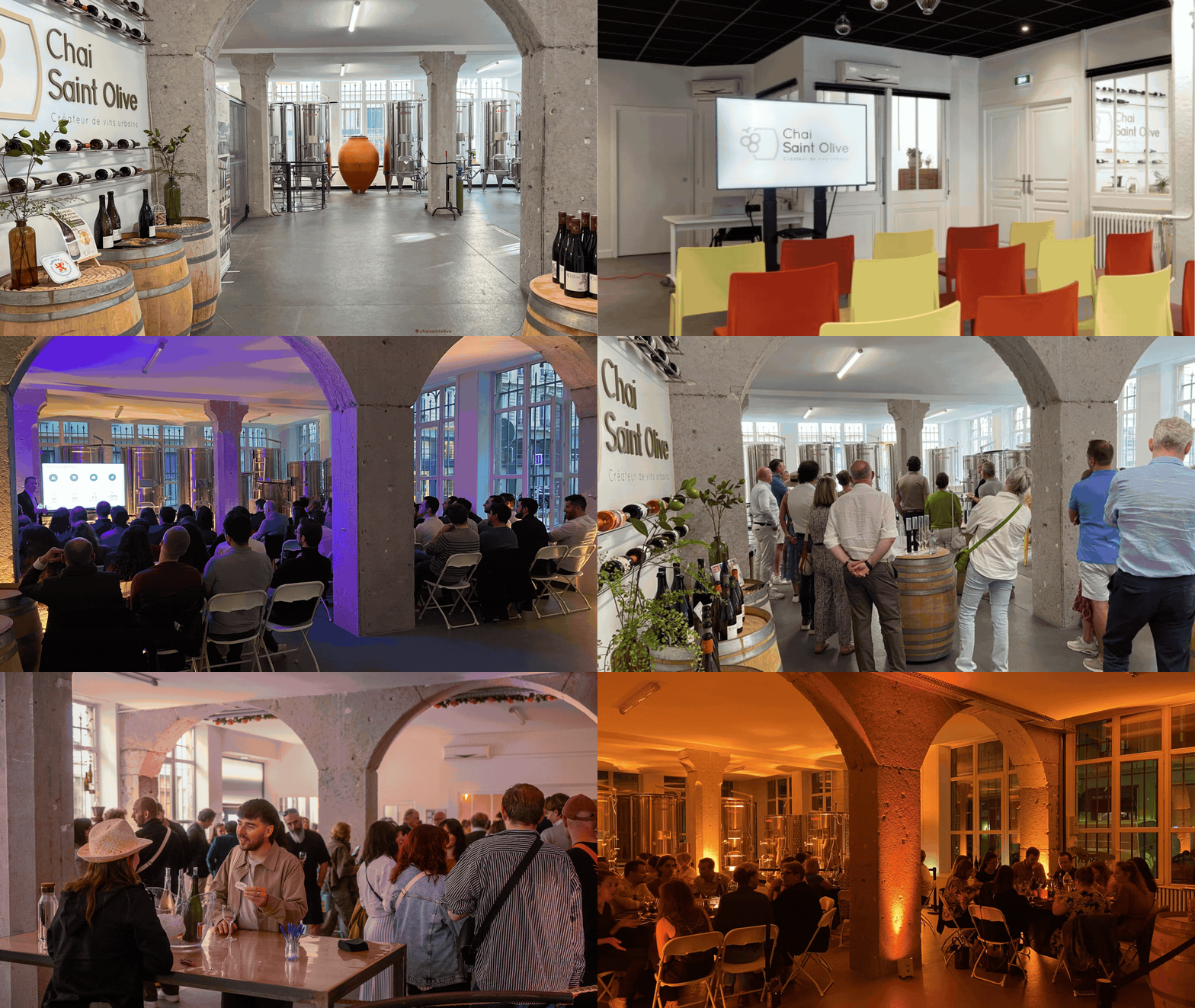
Located in the city center at 34 rue Malesherbes, in the 6th arrondissement of Lyon, the urban winery, named Chai Saint Olive, is the first urban winery in Lyon:
- wine production site,
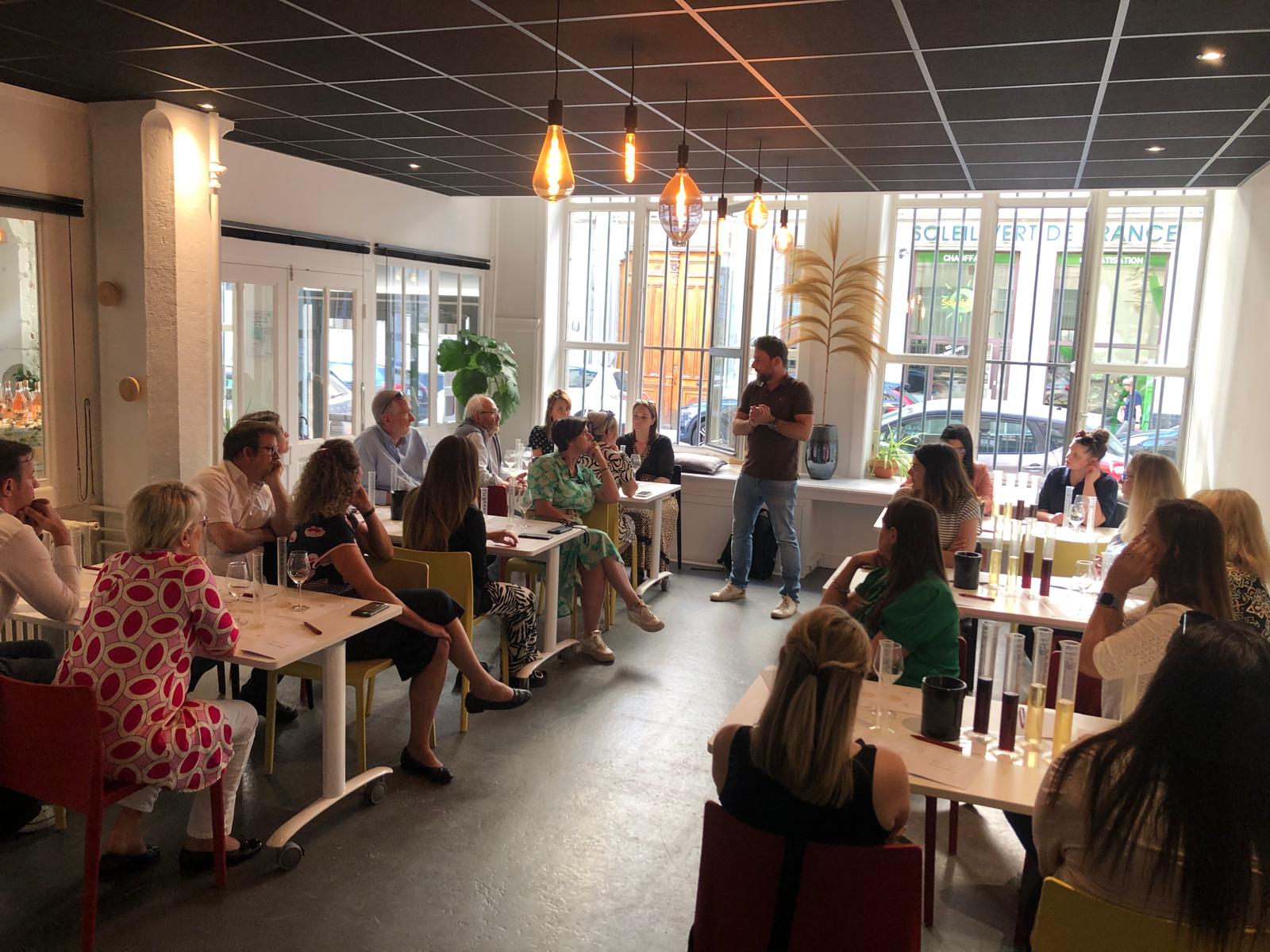
- a place of learning through wine workshops such as the Winery Visit & Wine Tasting Workshop in Lyon or the Blending Your Own Cuvée Workshop
- an unusual event venue for individuals and companies: showroom, seminars, team-building, private events, business meetings, management committee, film shoots, etc.
For the Saint Olive brothers: "the creation of Chai Saint Olive® is the continuation of our adventure which started in 2014 when we created our own wine brand Saint Olive Frères®.
Our attachment to Lyon led us to establish ourselves in the heart of our hometown. We believe that each of us needs to see, understand, and consume more locally.
We offer this opportunity in a unique and authentic setting . Through this project, we also wish to highlight our winegrowers who, every day of the year, work on their land to provide us with quality grapes.
What are the wines from Lyon's first urban winery?
With regional roots being key to this initiative, the Saint Olive brothers have chosen to vinify only grape varieties from the Northern Rhône Valley and Beaujolais, sourced from estates located within 80 kilometers of the winery. Thus, production focuses on Gamay and Syrah for red wines, and Viognier and Chardonnay for white wines.
The production of Lyon's first urban wines was officially launched with the arrival of the musts at the end of August 2020 – the first stage of winemaking – and since then Chai Saint Olive has continued to expand its range with its special cuvées:
- its Natural Sparkling Wine – Trabulle
- Lyon's first organic rosé – Gamay rosé
- his Marsanne
- “Chardonnay "Quand on arrive en ville”
- and the Viognier made in an amphora
Join us on social media: